4 min read

Solvent-based workstations: what safety regulations require in Switzerland

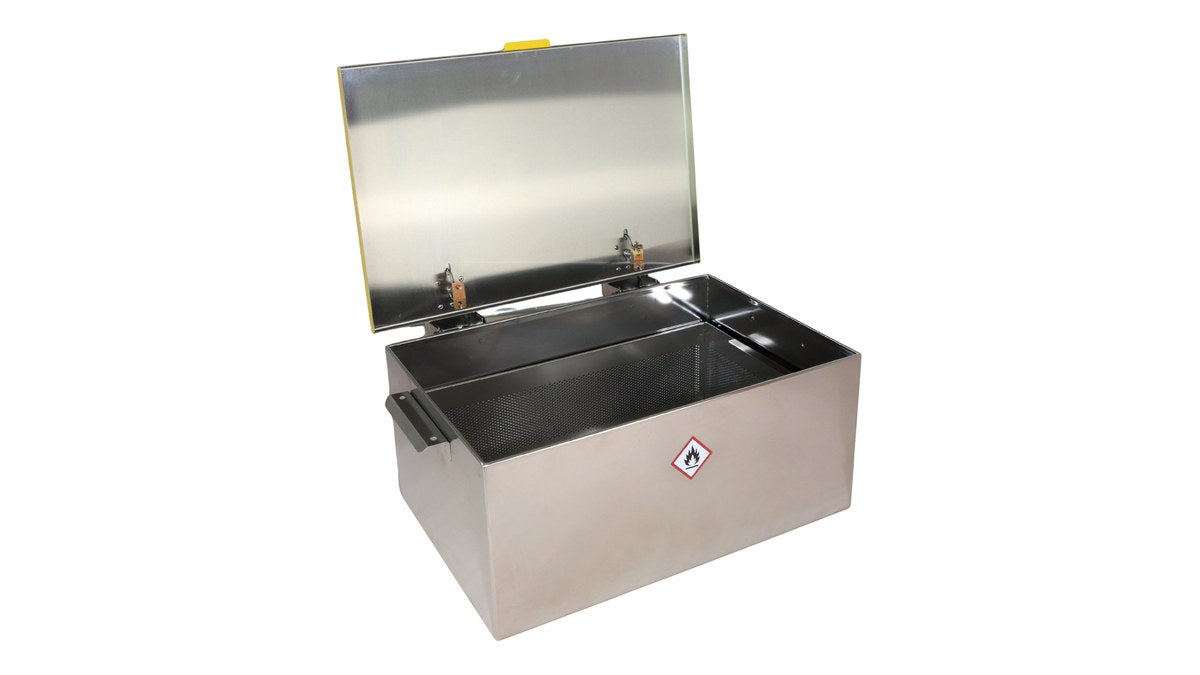
The lid of a benzine container is held by a copper piece that melts. If the solvent ignites, it gives way and the lid drops by itself.

Benzinière Geiger rectangulaire en inox, couvercle relevé retenu par ses fusibles en cuivre, tamis perforé

The lid of a solvent cleaning tank is not there to keep the solvent clean. It is held open by a copper link that melts at low temperature. If the contents ignite, the link gives way, the lid drops of its own accord and the fire smothers for want of air. A purely mechanical safety device that works without electricity and with nobody in the workshop.

The lid that closes itself

A safety device that needs nobody in use if the solvent ignites fusible link sieve solvent the link has melted no air the solvent stays accessible the flames are starved of air The fusible link is a wear part: it is not repaired, it is replaced.
The device works once only. After it has triggered, or once the link is deformed, the copper part must be changed before the tank goes back into service.

Three checks are enough, and they take ten seconds. Does the lid drop freely, with no stiff point and no seized hinge? Is the copper link present and undeformed? Does the sieve sit properly, so that parts do not soak at the bottom among the deposits?

The one move that cancels everything. A tank whose lid is propped open with a rag, a screwdriver or a workpiece is no longer a safety tank. It is an open container of flammable solvent sitting on a bench. Propping is the first thing an inspector looks for, because it is the most common.

Why 30 °C is the threshold that matters

The Swiss accident insurance fund, SUVA, draws a clear line: a flammable liquid becomes dangerous as soon as its flash point falls below 30 °C. Below that, a mixture of vapour and air forms above the liquid that can explode. A match flame, a hot surface or a single electrostatic discharge spark is then enough.

Flash points and the danger threshold below 30 °C an explosive mixture forms at room temperature danger zone per SUVA 30 °C threshold benzine isopropanol white spirit below 0 °C about 40 °C −10 0 10 20 30 40 50 °C Indicative values. Your product's flash point is in section 9 of its safety data sheet.
Benzine sits far below the threshold. Substituting a heavier solvent lowers the risk, but isopropanol still falls below 30 °C.

The same flash point then serves another purpose. Swiss fire protection uses it to classify liquids: up to 23 °C they are classes 1 and 2, from 23 to 60 °C class 3, and above 60 °C there is no classification at all. That class is what will determine how much you are allowed to keep on site.

Vapours flow along the floor

This is the point SUVA states most plainly, and the least intuitive one. Solvent vapours are heavier than air, invisible, and spread across the floor like liquids. They do not rise, they sink, spill over the edge of the bench and travel at floor level until they find an ignition source several metres away.

Vapours do not rise, they sink solvent tank ignition source Socket, extension lead, grinder, heater, floor drain: the source can be metres away. Look at floor level, not at eye level.
This is why a solvent station cannot be judged standing up. It is judged crouching: what matters is what sits at floor level within a radius of several metres.

The rag trap. Cloth soaked in solvent or oil, piled into an open bucket, can heat itself by oxidation until it ignites, with no external source at all. It belongs in a metal container with a lid. Never in a cardboard box, never in a bag.

The three documents to have. The safety data sheet of the solvent you actually use, which gives the flash point in section 9 and the handling measures in section 7. The SUVA checklist 67071 on the storage of highly flammable liquids, which is free and designed to be filled in. And the contact details of your hazardous waste contractor, before you need them. Outside Switzerland, your national safety authority publishes equivalent documents.

So, is the copper link on your tank still in place? Tell us in the comments.

The 30 °C threshold and the behaviour of vapours follow SUVA guidance on flammable liquids. Quantities and liquid classes follow the Swiss fire protection code AEAI 26-15 "Dangerous substances". Disposal follows the Swiss Ordinance on the Movement of Waste, SR 814.610. Flash points are indicative. This article is for information and is not a compliance assessment: the applicable measures depend on the product used, the quantities and the room. SUVA and your cantonal inspectorate answer enquiries from companies.

Frequently asked questions

How much solvent may be kept at the workstation?
The day's requirement. Beyond that it legally counts as storage, and the permitted quantity then depends on the fire class of the flammable liquid and on the fire protection equipment in the room, per Swiss fire protection code AEAI 26-15, chapter 3.4.
Where should a solvent container be kept between uses?
In a closed container, placed in a ventilated fire-resistant cabinet and standing in a retention tray, clear of escape routes and away from any ignition source. SUVA checklist 67071 on the storage of highly flammable liquids allows this to be verified point by point.
How should a used solvent bath be disposed of?
A used solvent bath is hazardous waste: it must be handed to an authorised disposal company together with a numbered movement document, in accordance with the Swiss Ordinance on the Movement of Waste, SR 814.610. It must never be poured down the drain or thrown out with general refuse.
How often should the solvent in a cleaning tank be changed?
No rule sets a frequency: the change is judged on results, meaning persistent cloudiness, deposits that stay on the sieve, or a greasy film after drying. Waiting saves nothing, because a saturated bath cleans less well and concentrates the contaminants.
What is the copper part on the lid of a solvent tank for?
It is a fusible link: it holds the lid open and melts if the solvent ignites, which lets the lid drop and starves the flames of air. It is a wear part, to be replaced after it has triggered or once it is deformed.
Why are solvent vapours dangerous at floor level?
Solvent vapours are heavier than air and invisible: they sink along the bench and spread across the floor like a liquid, until they reach an ignition source several metres away. A solvent station is therefore inspected crouching, not standing.

Standards cited

  • FIEP 26-15
  • SUVA 67071
  • OMoD RS 814.610