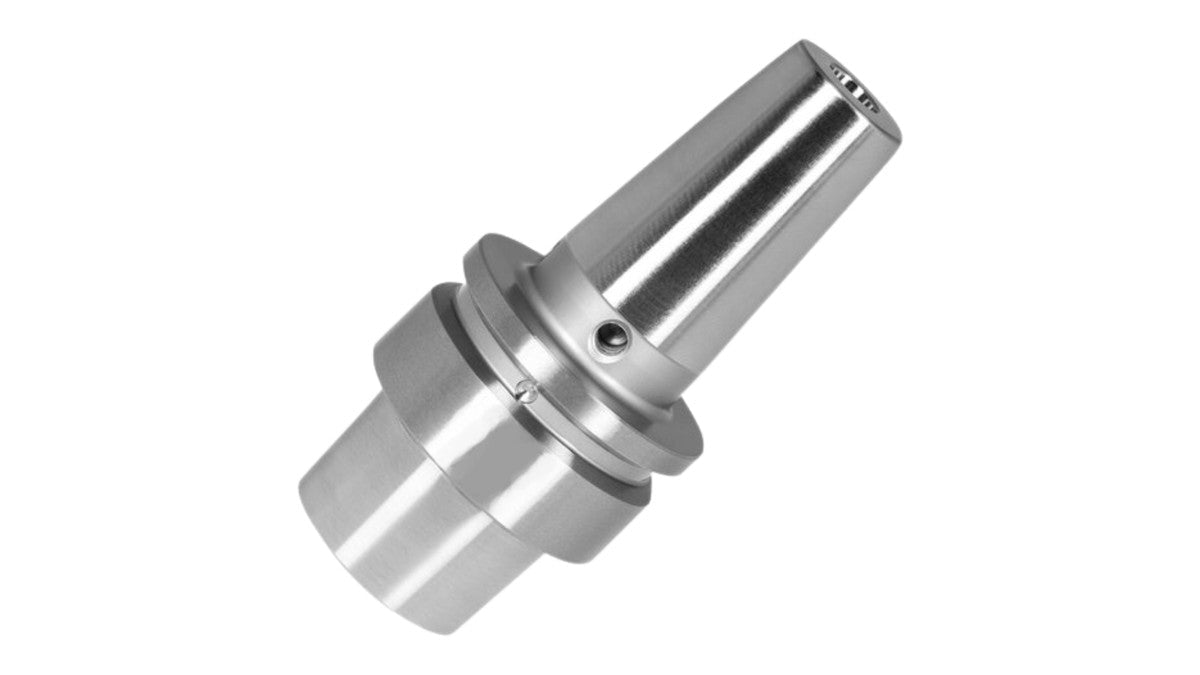
An HSK-A63 and an HSK-E63 have the same taper. Same diameters, same length, same 1:10 angle. What separates them lies in two slots machined at the end of the taper, and that difference decides everything: the torque that can be transmitted, the speed that is admissible and the finish obtained.
The number does not designate the taper either, but the flange diameter. That is why an HSK 63 in one form is not necessarily interchangeable with an HSK 63 in another.
The only difference that matters
On an HSK-A the torque passes through those slots as much as through friction on the taper. On an HSK-E it passes through the friction of the taper and face contact alone. That is the whole logic of the system: the HSK-A gains in torque what the HSK-E gains in runout.
| HSK-A | HSK-E | |
|---|---|---|
| Standard | DIN 69893-1 | DIN 69893-5 |
| Torque transmission | Drive slots and friction | Friction alone |
| Orientation in spindle | Imposed, one way only | Free, symmetrical profile |
| Balancing | On request | Standard at Schaublin |
| Sizes available | 25 to 63 | 20 to 63 |
| Transmittable torque | High | Moderate |
| Rotational speed | Moderate to high | Very high |
| Territory | General milling, roughing | Micro-machining, finishing, HSC |
The trade-off in one picture
That is the principle on which the system was built. The taper is elastic: it deforms with the spindle. And simultaneous contact on the taper and on the face prevents the toolholder from being drawn in, which guarantees reliable length presetting from one tool change to the next.
Why the HSK-E wins in micro-machining
Removing the slots does more than remove one way of transmitting drive: it removes every source of unbalance. A perfectly symmetrical profile lends itself to balancing, which Schaublin applies as standard across its entire HSK-E range.
Balancing is not a catalogue refinement. It reduces vibration, improves surface finish and extends the life of both tool and spindle. It is also what makes an asymmetrical toolholder usable beyond 10,000 rpm.
A second advantage, decisive in watchmaking: the HSK-E goes down to size 20, which the HSK-A does not offer.
| Size | Flange D1 | D2 | D3 | Taper length L1 | HSK-A | HSK-E |
|---|---|---|---|---|---|---|
| 20 | 20 mm | 15.2 | 16 | 10 mm | — | ja |
| 25 | 25 mm | 19 | 20 | 13 mm | ja | ja |
| 32 | 32 mm | 24 | 26 | 16 mm | ja | ja |
| 40 | 40 mm | 30 | 34 | 20 mm | ja | ja |
| 50 | 50 mm | 38 | 42 | 25 mm | ja | ja |
| 63 | 63 mm | 48 | 53 | 32 mm | ja | ja |
The columns speak for themselves: at equal size, the taper dimensions are rigorously identical in A and in E. The Schaublin catalogue simply adds three further dimensions for the HSK-A, those of the slots.
Avoid an HSK-E for heavy roughing. Without slots, the torque passes through friction alone. Under heavy load the tool can slip in the taper. Conversely, an HSK-A pushed very high in speed introduces vibration through its asymmetry. Each form has a territory, and leaving that territory costs either a part or a spindle.

The six forms, and the ones that really exist
The taper is not enough
A perfectly balanced HSK-E loses its point if it holds the tool in a grip that deforms the shank. That is exactly the criticism levelled at Weldon and Whistle Notch millholders: radial clamping on the flat transmits high torque, but it deforms the tool, increases runout, degrades surface finish and shortens tool life. At micro-machining speeds, the sums do not add up.
Two mountings live up to the taper's promise. Type D collets, designed for HSC, with a shallower taper and a finer nut thread: the clamping force rises and does not collapse at high speed. And the shrink-fit millholder, which grips the tool with no moving part at all. Schaublin HSK collet holders are quoted at a runout below 3 µm.
Discover the complete Schaublin catalogue
Collet holders, shrink-fit millholders and HSK-A and HSK-E toolholders from size 20 to 63, collets for material and tool clamping, expanding mandrels: the full range is online.
Technical data from the Schaublin catalogue 476-4800, edition 06/2022 (Schaublin SA, Delémont), standards DIN 69893 and ISO 12164. The speeds quoted are indicative: the maximum speed of a spindle, toolholder and tool assembly can only be established by the machine manufacturer.