If you have a clamping key marked SV20 in a workshop drawer, you are holding the initials of two men. Charles Schäublin and Emile Villeneuve, partners from 1916. One hundred and ten years later, those two letters are still engraved on parts that leave the factory every week.
It is the kind of detail nobody notices any more. Yet the brands you handle every day carry a precise history, made of trains, bankruptcies, break-ups and rescues. It is worth the detour, because it explains why some parts can still be found and others cannot.

Three firms, one single history
1891: Tavannes invents the machine for watchmaking
It begins with a watchmaker named Henri-Frédéric Sandoz, who founded Tavannes Watch Co in 1891 in a village in the valley. His idea was not to make beautiful watches, it was to make a great many of them, well. He came back from visiting American industrialists convinced that series production is not the enemy of precision, and he applied their methods of rationalisation to Swiss watchmaking.
One thing was missing: the machines. Nobody was building tooling designed specifically for watchmaking. So Sandoz had them built in-house. That is where the Swiss watchmaking machine tool industry was born, almost by accident.
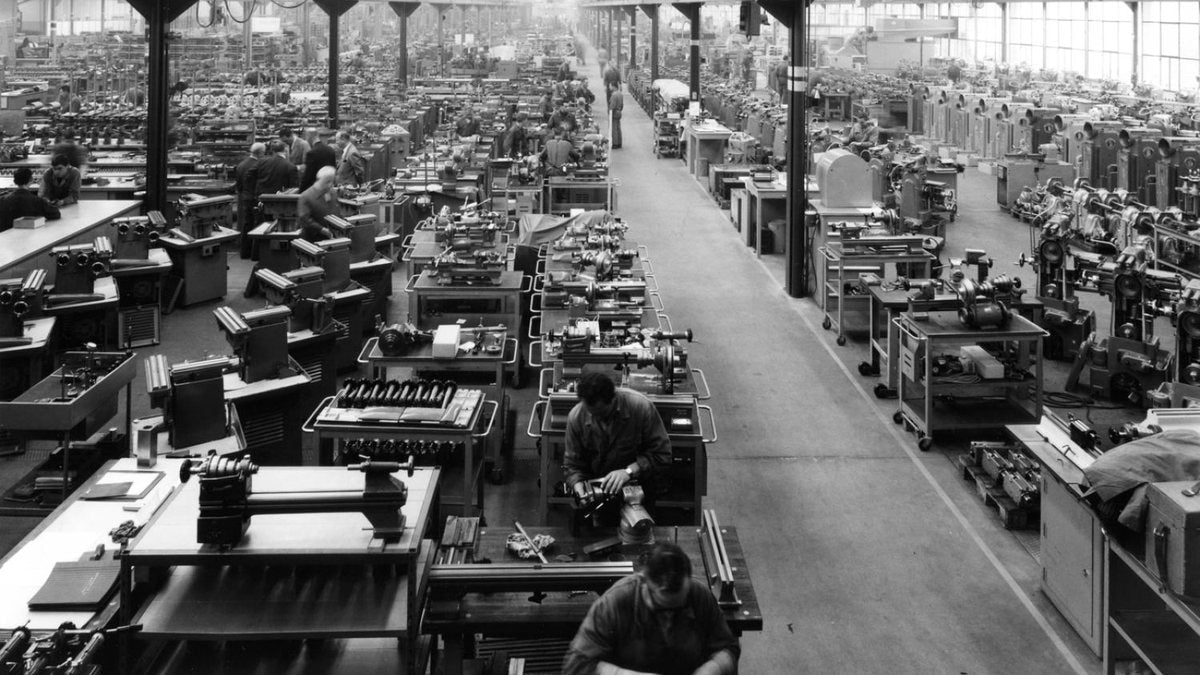
The success went beyond internal use. Between 1900 and 1930, some two thousand machines left the mechanical department and were sold to outside customers. In 1938 that department became independent under the name Tavannes Machines Co, with three hundred employees. At its height the parent company was the fourth largest watch manufacturer in the world: more than two thousand employees, four thousand watches a day, five factories.

One detail that explains a great deal. In 1940 a fire destroyed several factory buildings and most of the archives. That is why the history of Tavannes is harder to reconstruct today than that of its neighbours, and why so many machines circulate with no documentation.
8 April 1915: a train stops at Malleray
Charles Schäublin was born in 1883 at Waldenburg, the son of a locksmith. Placed as a commercial apprentice in a watch factory, he persuaded his father that the trade was not for him and served a mechanic's apprenticeship, finishing top of his year in 1903. Eight years followed at A. Schild in Grenchen, at Omega, and at Tavannes Watch.
That is the point everyone forgets: the man who would found Schaublin learned his trade at Tavannes. And his future partner, Emile Villeneuve, was a secondary school teacher in Tavannes. The two firms are not rivals by chance, they came out of the same soil.
On 8 April 1915 Schäublin's train stopped at Malleray, in front of a small factory left idle after a bankruptcy. He did not think about it for long: a promise of sale was signed the next day. A year later Villeneuve joined him, bringing the commercial and financial side while Schäublin kept the technical one. The firm was called Ch. Schäublin-Villeneuve, and its registered mark was an S interlaced with a V.
Hence the SV70 and SV12 lathes. And hence, still today, the SV10, SV12, SV20 and SV25 clamping keys in the collet catalogue. The mark has outlived the change of company name in 1946, two successive owners and an entire century.
What followed is a lesson in industrial development. Collet production started at Malleray in 1920. Four years later a branch opened at Delémont to make them, with eighteen people. The patent for the bed and the fixing system of the 65 and 70 lathes was filed four years after the founding, and it is still in service today. Then came Bévilard, a pension foundation in 1941, low-rent housing, and a factory at Orvin in 1954 opened explicitly to slow the drift of young people to the city.
In all, more than one hundred thousand Schaublin 70 and 102 lathes were built. There is probably one within twenty kilometres of where you are.
1986: Tavannes Machines breaks into five
Bought in 1966 by Ebauches SA and Chronos SA, Tavannes Machines did not survive the watch industry crisis. The works closed in 1986 and the company was sold off in lots. That break-up is what explains where its skills went.
This is the most surprising fact in the whole story. The Tavannes name has outlived the company that created it by forty years, carried by another firm, in another village, on just one of its former activities. When you pick up a Tavannes horizontal micrometer or a set of T-A anvils, you are holding the last intact thread of a works that closed in 1986.
2000: Schaublin becomes two companies
Schaublin stayed a family business until the end of the century. Then, in two stages, everything separated along the line that had already existed since 1924: the machines on one side, the collets on the other.
That is what the mention Schaublin RBC on our product pages means. RBC for Roller Bearing Company, the American group that has owned the Delémont works since 2000. The W collets we sell come from there. Schaublin lathes, on the other hand, come from Bévilard, from a legally separate company.
1940: Tripan, four pairs of hands
Tripan's history is shorter but more eventful. The first drawings date from 1940 according to the archives, and the brand's reputation goes back to 1934. Prematex SA made this tooling under two names depending on the continent: Tripan for Europe, Levin for America, after a lathe builder based in Santa Fe.
What came next concerns us directly. SwissKH, founded by Bryan Gosparini around the restoration of old machines, bought the trademarks in 2018, wrote to five continents to find the customers again, and rebuilt the stock. Since then the commercial management and worldwide distribution of Tripan and Supercoup run through heidi.shop, while the trademarks and their technical development stay with SwissKH. We are the latest link in a chain that began before the war.
What your workshop says
| What you may have to hand | What it tells you |
|---|---|
| An SV20 clamping key | The initials of Schäublin and Villeneuve, partners from 1916 |
| A Schaublin 70 or 102 lathe | One of a hundred thousand built at Bévilard, on a bed patented in 1919 |
| A W20 collet bought this week | Delémont, a works opened in 1924 for collets, with eighteen people |
| A Tavannes micrometer | The only Tavannes Machines trade that survived 1986, taken over at Court |
| A Tripan 131 toolholder | A design from the 1940s, produced without interruption except in 2017 |
| A Niederhauser chuck on your 102 | A whole ecosystem of workshops that lived off Schaublin |

Why it still matters
This history is not decorative, it has practical consequences. Tooling whose brand has changed hands four times can still be found, because each time somebody judged the range worth taking over. Tooling whose company was dispersed at auction, like the Tavannes presses and Gyromatic lathes in January 1987, cannot.
It also explains an oddity of the trade: the tooling outlives the machines. The bed patented in 1919 is still in service. Collets designed in the 1920s can still be ordered. A toolholder drawn in 1940 fits a machine delivered last year. When you buy Schaublin or Tripan, you are buying something that will probably outlive the lathe you mount it on.
The Malleray factory where Charles Schäublin stepped off the train in 1915 was, for its part, the subject of a demolition project in 2012, to make way for flats.
Discover the firms we represent
Schaublin, Tripan, Supercoup, Tavannes, Azurea, Niederhauser, Giroud and the others: brands from the Jura Arc and beyond, whose ranges are still very much alive.
Sources: Historical Dictionary of Switzerland, entry on Charles Schäublin. Dictionnaire du Jura, entries on Schäublin SA and Tavannes Machines Co SA. Chronologie jurassienne. Mémoires d'ici, Tavannes Watch Co collection. Company histories published by Schaublin SA, Schaublin Machines SA and Tripan. Schaublin 476-4800 and Tripan 2021 catalogues. The founding location of Schaublin varies between Malleray and Bévilard depending on the source: we have kept Malleray, in line with the company's own history.