"I have a Schaublin 102, which series do I need?" That is the question we are asked most often. The answer lies in three measurements taken from the lathe, and it is not the one most people assume.
Two parts, one principle
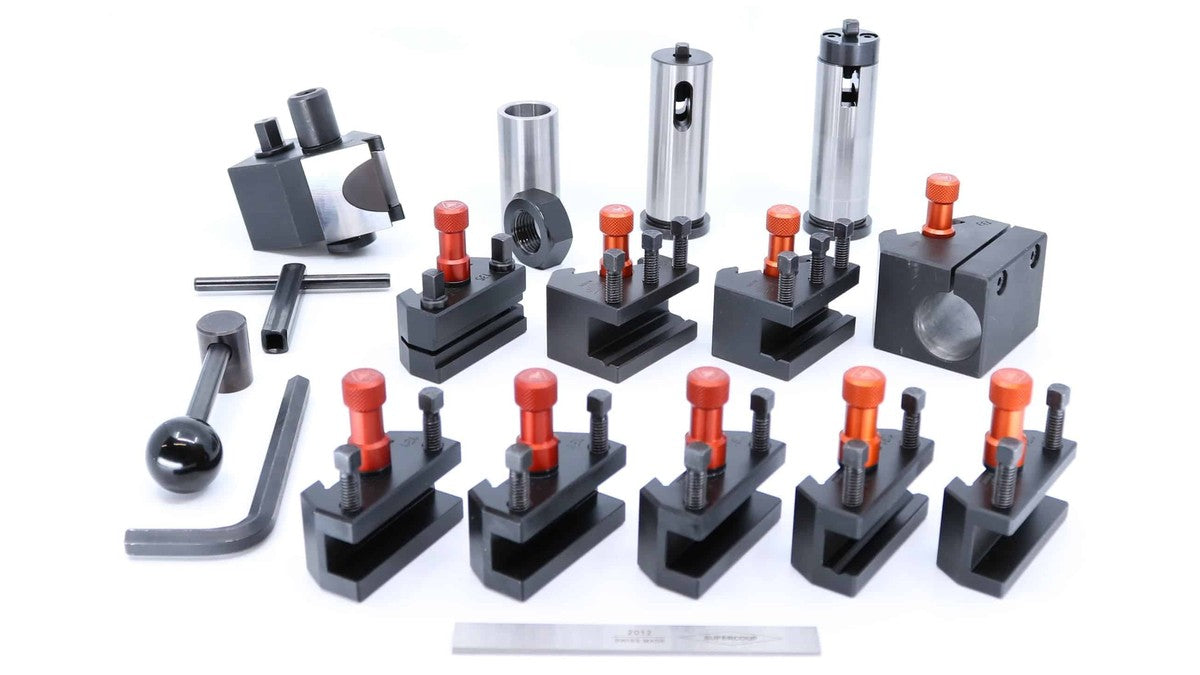
The clamping unit is fixed to the slide once and for all. The toolholder engages in it by a dovetail and locks with a lever. There is one clamping unit per series, and as many toolholders as there are operations.
The point is not only the speed of a tool change but equally its repeatability. A toolholder set once returns to its position to within a micron when it goes back onto the unit. You set up facing, you switch to parting, you put facing back on: the dimension is there.
Find your series on this axis
The measurement that decides is the centre height, the distance between the mounting face of the slide and the spindle axis. Take it from your lathe and read vertically.
If your lathe appears below, you have the answer without measuring anything.
| Series | Compatible lathes |
|---|---|
| 00 | Bergeon 50, Lorch, Boley, Levin, Star, Horia, Blösch, Favorite |
| 0 | Schaublin 70, Vector, Star, Favorite |
| 1 | Schaublin 102, 225, 302 · Myford, Emco, Simonet, ROMI C-420, Haas, Colchester, Hardinge, Gildemeister · 111S-U version for Unitor lathes |
| 2 | Schaublin 125 and 150 · dedicated 211S SV125 and SV150 versions · Romi, Kern, Haas, Hardinge (adapter base plate) |
| 3 | ROMI C-420 and C-520 · Kern, Haas, Colchester, Gildemeister (adapter base plate) |
The power gap is also a marker
An undersized clamping unit does not break, it vibrates and it marks. That is why power is directly tied to centre height where the two overlap: between a series 1 that only just fits and a comfortable series 2 on a 4.5 kW lathe, take the series 2.
Compatibility only works one way
Three consequences. A series 1 toolholder fits a series 2 unit, the reverse is impossible. Series 00 and 0 exchange nothing, neither with each other nor with the rest.
The order of checking. First the clamping unit you own, then the toolholder series it accepts, and only after that the type of opening. Doing it the other way round means choosing a tool and then discovering it does not fit.
Decoding a reference in three seconds
The suffixes give the variant: B for a V opening, C for an enlarged opening, D · L · U · Y for offset, extended, relieved or angled geometries, S on a clamping unit supplied with a drawbar.
Exceptions worth knowing. The bar holders of series 2 and 3 are called 244 and 345, not 233 and 333. Threading toolholders carry the suffix 90 (190, 390). And the 259-x and 21xx blade holders are adapters independent of the series: here it is the size of the blade that decides.

Parting: which blade, which holder
Two ways to mount a Supercoup blade. The dedicated blade holder, that is 35, 135, 235 or 335, mounts like any other toolholder. Or a 259-x adapter fixes onto a straight toolholder you already own.
| Blade | Dedicated blade holder | Adapters |
|---|---|---|
| Supercoup 2010 | Tripan 35 (series 0) | 259-0 · 2110 |
| Supercoup 2012 | Tripan 135 (series 1) | 259-1 · 2112, also on 131, 131B, 131C |
| Supercoup 2016 | Tripan 235 (series 2) | 2116 |
| Supercoup 2018 | — | 259-2 · 259-2A · 2118 |
| Supercoup 2020 | — | 2120 |
| Supercoup 2025 | Tripan 335 (series 3) | 259-3 · 259-4 · 259-5 · 2125, also on 231, 231B |
One detail breaks more blades than any setting: the blade must be clamped in the area of the holder provided for it, not as short as possible. See the Supercoup blades
The bar holder, the part not to forget
The 133 of series 1 is a ø27 mm bar holder. Its bore takes a range of bushings that turn it into a second-operation spindle: Morse taper 1 or 2 (133-1, 133-2), Schaublin B8 collet (133B), Schaublin W20 collet (133W), or a ø20 mm bar for boring (133-20).

In practice: you pick up a part on a precision collet, you drill on centre, you bore without dismantling anything, and you keep the repeatability of the system. Series 0 offers the same logic with the 33, series 2 with the 244, series 3 with the 345.
Kit or piece by piece?
The kits are not a disguised discount: they deliberately contain several examples of the same toolholder, because that is where the value of the system comes from. One toolholder per operation, set once.
The progression is easy to read. The START kits cover turning and parting. The PRO kits add the bar holder. The MASTER kits add the bushings, and therefore the Morse tapers and the Schaublin collets. You move up a step when you need the next function, not one more tool.
Unsure about your configuration?
Send us the make and model of your lathe, the centre height and the height of your tool bits. We reply with the series and the references that match.