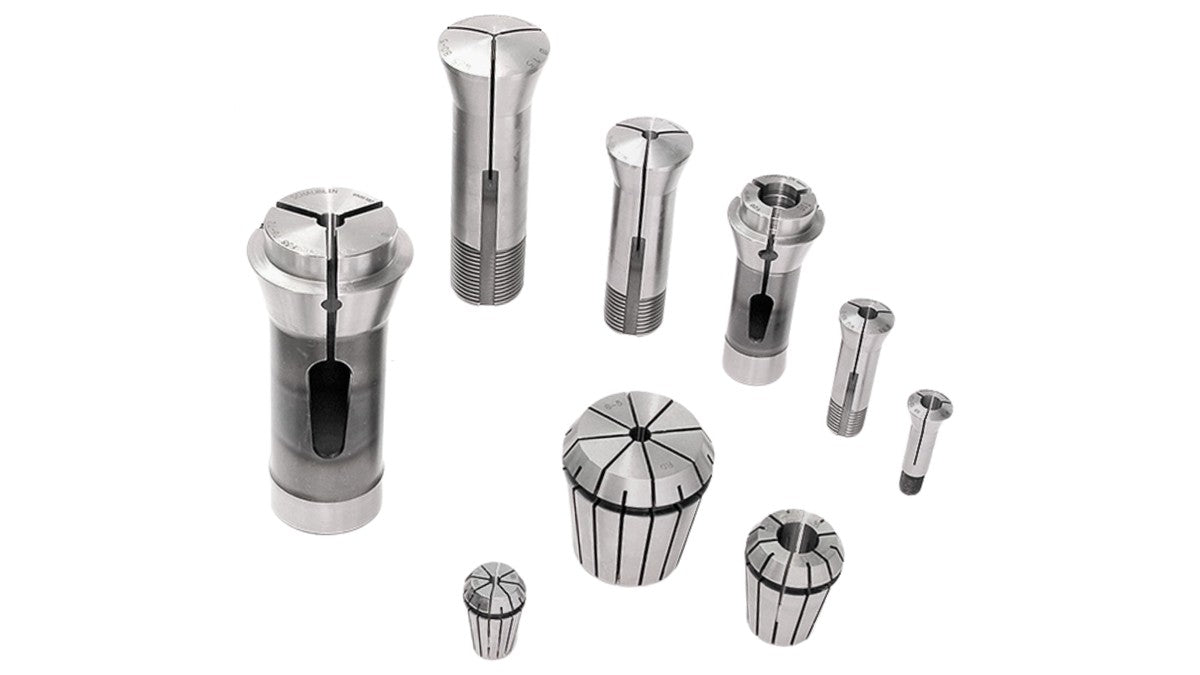
The number W20 on a Schaublin collet is not its maximum clamping capacity. A W20 clamps up to 20 mm, but a B32 stops at 24 mm, not at 32. The number designates the diameter of the body, the one that has to match the seat in your spindle.
That is the source of half the orders that go back. Schaublin has been making collets since 1915 and the nomenclature is perfectly logical, provided you know what each part of the reference designates.

Reading a reference
The article number reads the same way, and it is often the one you have in front of you: engraved on a worn collet, or copied from an old order on which the type does not appear.
First: the part or the tool?
Before the type, one question cuts the catalogue in two. Collets A, F, W, B, L, P clamp the material, that is the bar or the part in the spindle. Collets EX, ESX, ET1 and D clamp a tool by its shank, in a toolholder. The two families never cross.
For material clamping, everything then comes down to three ways of actuating a collet.
What size changes: the clamping force
Standard or ultra-precision?
Schaublin supplies every collet in two grades of precision. The standard execution is checked by AQL 1.0 sampling and is enough in most cases. The UP execution is checked at 100% and halves the radial runout, for a price premium.
The 0.1 mm rule. A pull-back collet opens very little. It is made to clamp its nominal diameter, and going more than 0.1 mm below it degrades concentricity. For an intermediate diameter, take the collet to size, not the next one up.
The bore: shape and finish
A collet does not necessarily clamp round stock. Square and hexagon are standard bores at Schaublin, just like round, and can be ordered from the catalogue. Any other profile is made to order, with slitting adapted to the profile.
Mind the dimension you pass on: on a profile it is the measurement across flats that counts. To know which collet size can take it, that has to be converted into the diameter across corners.
| Shape | Code | Dimension to give | Equivalent diameter | Availability |
|---|---|---|---|---|
| Round | ø | diameter | — | Standard |
| Square | C | across flats C | D = C × 1.414 | Standard |
| Hexagon | S | across flats S | D = S × 1.155 | Standard |
| Special profile | sketch | per drawing | to be calculated | To order, adapted slitting |
A hexagon of 10 mm across flats therefore calls for a collet capable of an 11.55 mm bore; a 10 mm square, a collet of 14.14 mm. That is why a profile consumes one collet size more than the nominal dimension suggests.
A profile is paid for in concentricity. A standard profiled bore allows 0.060 mm of radial runout, against 0.020 for a round bore of the same size, and 0.040 even in UP quality. If concentricity is critical, pick the part up again on a round bore.
That leaves the finish of the bore, which decides the grip. Schaublin quantifies the difference through the coefficient of friction between the collet and the part.
| Finish | Available from | Coefficient of friction | Trade-off |
|---|---|---|---|
| Smooth | all dimensions | 0.05 to 0.30 | Does not mark the part |
| Grooved | ø 9 mm round · 14 mm profiled | 0.20 to 0.40 | Grips markedly better, marks slightly |
| Serrated | ø 14 mm | 0.30 to 0.60 | Grips best, marks most |
Going from smooth to serrated can multiply friction by six, and therefore the torque transmissible before slipping. On type F push collets, incidentally, round bores are smooth up to ø 8.99 mm and grooved as standard from 9 mm.
Tool clamping: EX, ESX or D
| Type | Standard | Clamping range | Use |
|---|---|---|---|
| EX | DIN 6499-A | nominal diameter only (ISO h12) | Ultra-precise concentricity |
| ESX | DIN 6499-B | 0.5 to 1 mm downwards | Standard, one tool per range |
| ET1 | — | standardised dimensions | Tapping, integrated axial compensation |
| D | Schaublin standard | nominal diameter, UP quality | High-speed machining and ultra-precision |
All of them have an extraction system that releases the collet from its seat as the nut is loosened. Type D is Schaublin's answer to high-speed machining: a shallower taper and a finer nut thread, which raises the clamping force and maintains it at high speed. A more stable and safer system than ESX or EX in fast rotation.
Beyond the round collet
The same collet body serves as the basis for a whole family of tooling, which saves tying up a spindle for a special case. The rough-bored funnel collets are machined to size to clamp an external shoulder, the step collets do the same from the inside, the expanding mandrels hold a part by its bore, and the tapping collets provide axial compensation. All of them draw on the F, W or B bodies.
Discover the complete Schaublin catalogue
Collets for material and tool clamping, funnel and step collets, expanding mandrels, nuts, depth stops and HSK toolholders: the full range is online, with the diameters and the standard and UP qualities available for each.
So, which collet type is in your spindle? Tell us in the comments.
Technical data from the Schaublin catalogue 476-4800, edition 06/2022 (Schaublin SA, Delémont). Check the type and the body diameter on your spindle before ordering.